Static filtration panel
Provide overall size, active area, slot, flow direction, support method, material and the retained media or particles.
KUNYU GROUPWedge Wire Screen Team

CUSTOM INDUSTRIAL SCREEN COMPONENTS
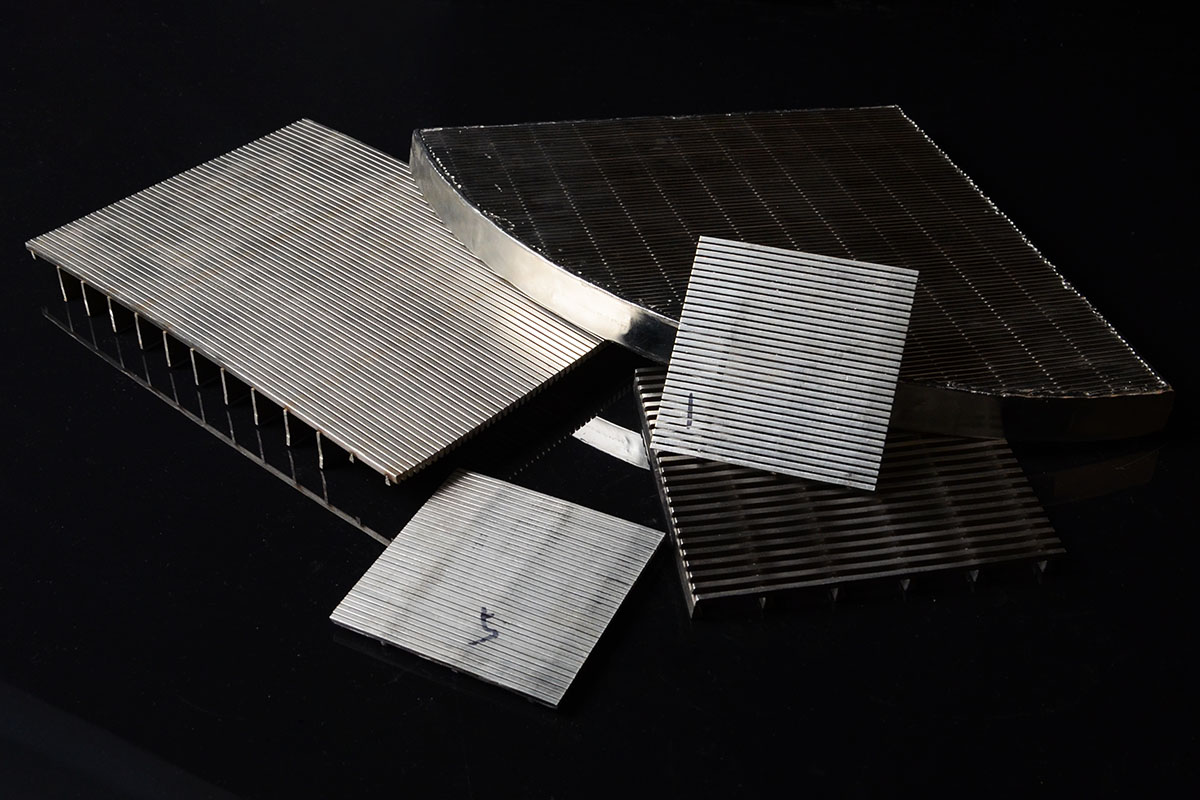
A wedge wire screen panel is a flat or formed screening surface made from profile wires attached to support rods. Continuous slots separate material while the support arrangement and frame connect the panel to the equipment.
Panels suit filter beds, drainage surfaces and OEM screening assemblies where a defined screening area must fit an existing support structure. A panel selected for a static filter is not automatically suitable for a vibrating machine: loading and mounting need a separate review.
CONFIGURATION REFERENCE
The photographs below are third-party industry references that illustrate common panel construction and drawing details. They are not Wedge Wire Works production or completed-project claims. Final dimensions, slot direction, support spacing, framing and duty must be confirmed against the buyer’s drawing.

A flat panel starts with overall size, active screening area, slot direction and support spacing; edge framing remains drawing-defined.
Industry reference image: Made-in-China supplier reference.
Profile wire, support profile, pitch and load direction should be stated together instead of treating slot opening as the only specification.
Industry reference image: Johnson Wedge Wire.
Replacement and OEM panels may require plain edges, welded frames, fixing holes or formed sections to match the equipment interface.
Industry reference image: ADEN Wedge Wire.Use this checklist for an enquiry or drawing review. Dimensions and slot openings are specified for the project; the table is not a stock-size or guaranteed-capability range.
| Parameter | Information to provide | Why it matters |
|---|---|---|
| Panel envelope | Overall length × width, thickness and usable screening area | Separate the outside frame size from the exposed screen surface. |
| Slot opening | Nominal slot in mm; required tolerance and inspection method | The opening is the clear gap, not the wire centre-to-centre pitch. |
| Surface and support | Profile wire direction, support rod direction and spacing | Unsupported span and process load affect the support design. |
| Frame and fixing | Frame section, hole centres, fasteners and edge treatment | Include the equipment interface and any access limits. |
| Operating duty | Medium, flow direction, temperature, load or differential pressure | State cleaning, vibration and abrasion conditions where relevant. |
These are illustrative enquiry profiles, not completed-project claims. They identify the inputs needed before a panel construction can be reviewed.
Provide overall size, active area, slot, flow direction, support method, material and the retained media or particles.
State machine model, deck position, loading, vibration conditions, clamping method and the equipment manufacturer’s acceptance criteria.
Send the drawing revision, edge and frame details, fixing points, wear pattern, quantity and photographs of the existing installation.
Identify the characteristics that decide whether the screen is acceptable for your equipment:
Ask for the required inspection records, sampling basis and material documentation in the quotation. Availability and scope need to be confirmed for the order. Review the documentation checklist.
Send the drawing revision, quantity and delivery destination. For a replacement, include installation photos, the equipment reference and any wear or fit problems.
Material grade, tolerances, minimum order quantity, packing, lead time and delivery terms are agreed in the quotation. A similar-looking product photograph is not a compatibility confirmation.
Send the frame drawing, seating dimensions, hole positions and photos of the installation. Identify clearance, sealing and support requirements so the panel-to-frame interface can be reviewed.
A smaller slot changes particle retention and available open area. Selection also depends on solids shape, loading, flow and cleaning. Specify the separation duty before treating slot size as the only design variable.
Send overall and active dimensions, slot direction, profile and support details, material, mounting or frame details, duty, quantity and destination. Unknown items can remain open for drawing review.
Email eric@kunyufencing.com or continue on WhatsApp. Attach drawings in your chosen app.