Stationary strainer basket
Provide housing or seat dimensions, rim and handle details, slot, flow direction, retained solids, differential pressure basis and cleaning method.
KUNYU GROUPWedge Wire Screen Team

CUSTOM INDUSTRIAL SCREEN COMPONENTS
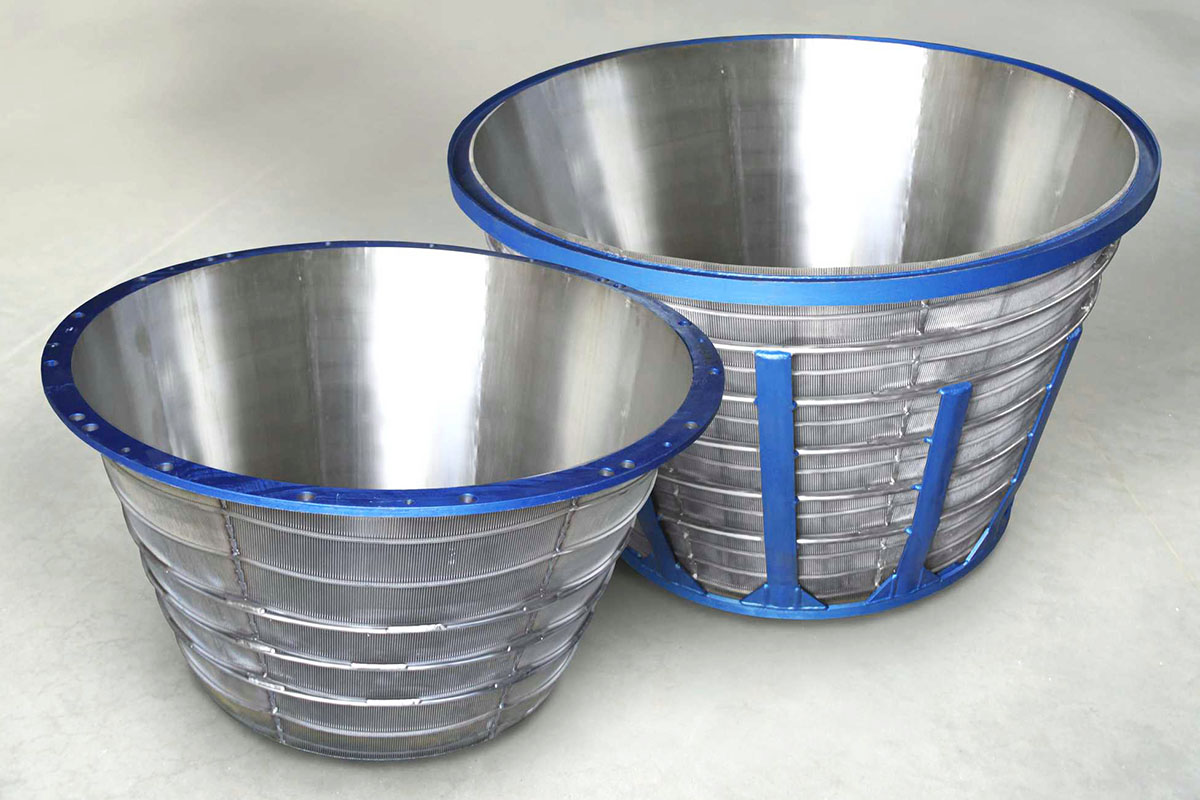
A wedge wire screen basket is a cylindrical, conical or shaped screening component with a slotted profile-wire surface. Its rims, supports and connections locate the basket within the separation equipment.
Screen baskets serve equipment-specific separation duties. For rotating equipment, speed, loading and the manufacturer’s acceptance criteria are essential inputs. A basket that fits the available space is not necessarily qualified for the intended rotational duty.
CONFIGURATION REFERENCE
The photographs below are third-party industry references that illustrate cylindrical, conical and removable basket arrangements. They are not Wedge Wire Works production or completed-project claims. Rotating or pressure duty requires the equipment designer’s drawing, loading and acceptance criteria.

Handled baskets require clear rim, handle, seating and removal-envelope details in addition to slot and overall dimensions.
Industry reference image: Boedon.
Top and bottom diameters, taper, height, flange, roundness and balance requirements must be drawing-controlled.
Industry reference image: Made-in-China supplier reference.
End plates, reinforcing rings, handles, flange details and flow direction can change with the housing and maintenance method.
Industry reference image: Made-in-China supplier reference.Use this checklist for an enquiry or drawing review. Dimensions and slot openings are specified for the project; the table is not a stock-size or guaranteed-capability range.
| Parameter | Information to provide | Why it matters |
|---|---|---|
| Basket envelope | Top and bottom diameters, height and taper where applicable | Show measurement datums and the active screen area. |
| Screening surface | Slot opening, profile orientation and flow direction | Identify which face receives the process material. |
| Mounting interfaces | Rims, flange holes, hubs and mating dimensions | Include the equipment drawing or measured interface details. |
| Equipment duty | Static or rotating use; speed, process load and temperature | For rotating service, provide the applicable balance and acceptance requirements. |
| Cleaning and wear | Cleaning procedure, abrasive solids and replacement history | Photographs of wear can help describe the existing problem. |
These are illustrative enquiry profiles, not completed-project claims. They separate stationary strainer requirements from rotating-equipment requirements.
Provide housing or seat dimensions, rim and handle details, slot, flow direction, retained solids, differential pressure basis and cleaning method.
State machine model, speed, loading, taper, balance requirement, fastening method and the OEM’s inspection and acceptance criteria.
Send the controlled drawing, equipment reference, photographs, wear pattern, fit problem, material requirement, quantity and destination.
Identify the characteristics that decide whether the screen is acceptable for your equipment:
Ask for the required inspection records, sampling basis and material documentation in the quotation. Availability and scope need to be confirmed for the order. Review the documentation checklist.
Send the drawing revision, quantity and delivery destination. For a replacement, include installation photos, the equipment reference and any wear or fit problems.
Material grade, tolerances, minimum order quantity, packing, lead time and delivery terms are agreed in the quotation. A similar-looking product photograph is not a compatibility confirmation.
Submit the equipment specification, operating speed, loading, drawing and required qualification or balancing criteria for review. Compatibility and rotating-duty acceptance must be explicitly agreed for the order.
Photos are useful for an initial discussion, but they do not establish critical dimensions, slot tolerance or duty requirements. Provide a drawing or a dimensioned measurement sheet before finalizing the replacement specification.
Send top and bottom diameters, height, taper, slot, profile and support arrangement, flange or rim details, duty, equipment reference, quantity and destination.
Email eric@kunyufencing.com or continue on WhatsApp. Attach drawings in your chosen app.