INDUSTRIAL SCREEN SELECTION
Wedge Wire vs Woven Mesh and Perforated Plate
Choose the screening medium around the separation duty, target opening, flow conditions, mechanical load, cleaning method and equipment fit. Wedge wire offers a rigid, slotted and cleanable construction; woven mesh can serve finer or flexible-media requirements; perforated plate can provide a robust coarse opening or a support layer. No single medium is the best fit for every process.
Compare the job before comparing screens
Start with the particle size distribution and shape, the allowable solids passage, normal and peak flow, medium chemistry, temperature, pressure or impact, and how the screen will be cleaned. Record the installation envelope and mating connections for a replacement. A nominal opening alone does not establish actual retention, capacity or service life.
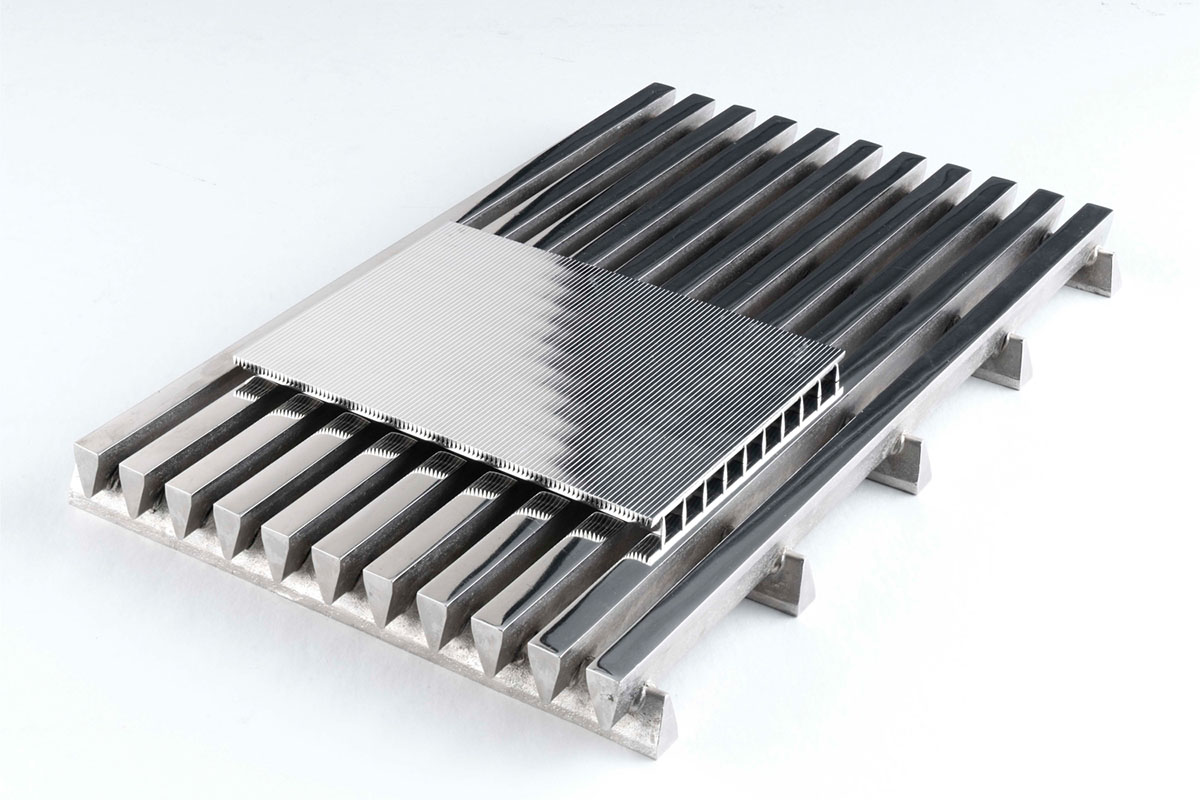
Wedge wire, woven mesh and perforated plate at a glance
| Decision factor | Wedge wire | Woven wire mesh | Perforated plate |
|---|---|---|---|
| Opening and structure | Continuous slots made by profile wire fixed to supports; specify nominal clear slot and tolerance. | Interlaced wires form apertures; weave and wire diameter affect the opening and flexibility. | Punched or otherwise formed holes in a sheet; define hole shape, pitch, thickness and edge margins. |
| When to consider it | A rigid, cleanable screening surface is needed for a suitable slot, load and available space. | A finer opening or flexible medium is needed and the support arrangement can be designed accordingly. | Coarse screening, mechanical protection or a support plate is needed; it may also carry another filter medium. |
| Cleaning and wear | Check access to the working face, allowable cleaning direction, support joints and slot wear. | Check blinding, weave damage, attachment and whether cleaning changes the aperture. | Check hole blockage, plate wear, attachment and access to both sides. |
| Quote inputs | Slot, profile, supports, flow direction, alloy, dimensions, connections and inspection scope. | Aperture, weave, wire diameter, material, support, fastening and change-out method. | Hole pattern, thickness, material, open area, edge design, supports and mounting. |
Cartridge, membrane and other fine filtration stages may serve a different duty from a coarse or intermediate mechanical screen. Compare them as parts of a process train, rather than assuming that a wedge wire element replaces every filtration stage.
What the wedge wire quotation must make clear
For an OEM or replacement component, define the overall and active dimensions separately. Mark the screening face and flow direction; specify the clear slot with its required tolerance, wire and support arrangement, material grade, service conditions and connections. If open area is being compared, distinguish theoretical surface open area from installed net area and measured hydraulic capacity. Our worked open-area guide explains that distinction.
Ask every supplier to quote against the same drawing revision and inspection scope. The screen specification guide and quality checklist show the fields to agree before ordering.
Choose the screen form for the equipment
- Panels suit drawing-defined flat screening or drainage surfaces.
- Cylinders and tubes need confirmed diameter, active length, flow direction and ends.
- Sieve bends need arc, feed direction and mounting details for static dewatering.
- Baskets need shape, rim and duty details; rotating service requires an equipment-specific review.
Technical references and scope
HAVER & BOECKER's media comparison discusses the trade-offs between woven mesh and wedge wire. Hendrick's wedge wire overview describes screen forms and construction. These are third-party technical references, not Wedge Wire Works production records or performance claims.